
- Sign in
- Register
Or Login Using
Please wait. Signing you in...
Or Login Using
Please wait. Signing you in...
0
$0.00

BATCH
PURITY
99% HPLC
Collagen ProductionDermal RepairSkin Elasticity
$235.00
Only the lyophilized product is provided. For research use only. All supplies sold separately.

Pharmacodynamics: KPV is a melanocortin-derived tripeptide that regulates immune activity by inhibiting NF-κB signaling and reducing the expression of pro-inflammatory cytokines such as TNF-α, IL-1β, and IL-6⁵⁻⁷. This action supports immune balance across skin, gastrointestinal tissue, joints, and connective tissue.
Mechanisms: By lowering chronic low-grade inflammation without suppressing normal immune defense, KPV creates a permissive biological environment for tissue renewal. This regulatory effect helps preserve collagen integrity, maintain epithelial barriers, and reduce inflammation-driven degradation associated with aging and chronic stress⁵⁻⁷.
Pharmacodynamics: GHK-Cu is a tripeptide-copper complex that influences gene expression related to collagen synthesis, elastin production, angiogenesis, and extracellular matrix remodeling⁸⁻¹⁰. It plays a central role in maintaining structural integrity across skin, vasculature, and connective tissue.
Mechanisms: Its activity includes antioxidant modulation and fibroblast activation, contributing to improved tissue strength, elasticity, and resilience. These effects support both internal connective tissue health and visible refinement of skin structure and tone⁸⁻¹⁰.
Pharmacodynamics: TB-500 is a synthetic fragment of Thymosin Beta-4 that facilitates tissue regeneration by regulating actin polymerization, enhancing cellular migration, and promoting angiogenesis¹⁵⁻¹⁷. It is particularly active in musculoskeletal and connective tissues.
Mechanisms: By supporting cell mobility and vascular development, TB-500 helps optimize tissue remodeling and recovery following physical stress, inflammation, or cumulative mechanical wear. Its effects contribute to improved tissue adaptability and long-term structural integrity¹⁵⁻¹⁷.
Pharmacodynamics: BPC-157 is a cytoprotective peptide derived from body protection compounds that promotes angiogenesis, stabilizes endothelial function, and accelerates tissue repair by modulating growth factors and inflammatory mediators¹¹⁻¹⁴.
Mechanisms: Its ability to support microvascular integrity, enhance fibroblast migration, and reduce oxidative stress facilitates recovery across muscle, tendon, ligament, nerve, gastrointestinal lining, and skin. These mechanisms support both functional repair and optimization of tissue architecture at a systemic level¹¹⁻¹⁶.
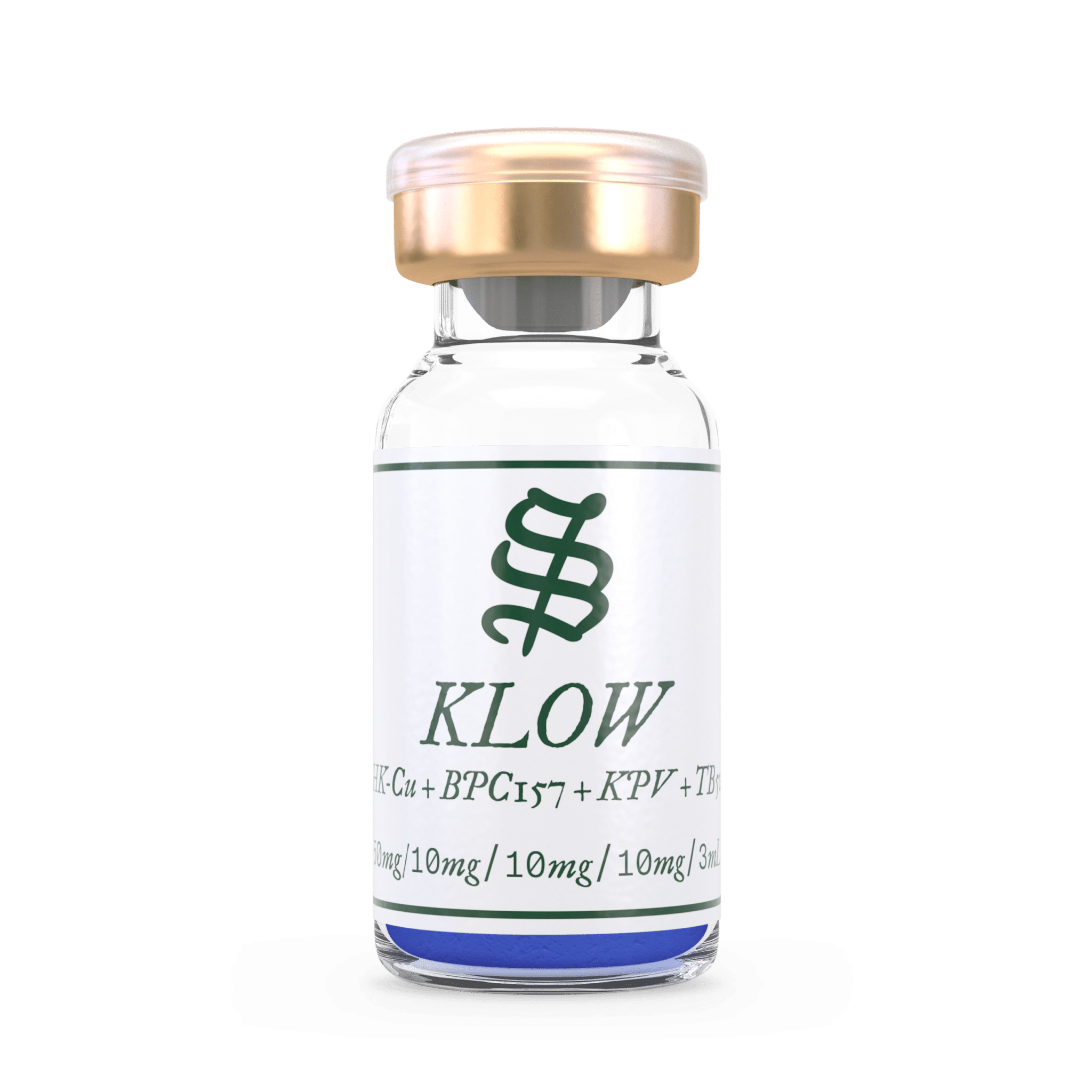
Through these complementary pharmacodynamic actions and mechanisms, KLOW supports coordinated inflammation regulation, tissue remodeling, collagen refinement, and microcirculatory function across multiple systems. Improvements in skin firmness, texture, and resilience occur alongside enhancements in musculoskeletal, vascular, and epithelial tissue quality—reflecting integrated biological optimization rather than isolated or superficial effects.
Inflammation Control as a Prerequisite for Tissue Quality
KPV has demonstrated potent suppression of inflammatory mediators such as TNF-α and IL-6, which are implicated in connective tissue degradation, impaired regeneration, gut barrier dysfunction, and inflammatory contributions to skin aging⁵⁻⁷. Reducing this inflammatory background allows regenerative and remodeling pathways to function more effectively.
Coordinated Regeneration Across Tissue Types
BPC-157 and TB-500 act synergistically to enhance angiogenesis, cellular migration, and tissue remodeling. These mechanisms support optimization and recovery in muscle, tendon, ligament, nerve, vascular endothelium, epithelial surfaces, and dermal structures alike¹¹⁻¹⁷.
Collagen Remodeling & Structural Refinement
GHK-Cu activates gene pathways involved in collagen synthesis, elastin production, and extracellular matrix organization. These effects translate to improved tensile strength and elasticity in connective tissue and vasculature, while also supporting visible improvements in skin firmness, density, and texture⁸⁻¹⁰.
Skin Appearance as a Parallel Outcome of Systemic Optimization
Improvements in skin quality observed with this peptide combination—such as enhanced tone, texture, and resilience—reflect normalization of inflammation, improved microcirculation, and optimized collagen turnover. These processes are equally relevant to joint, tendon, gut, and vascular health, positioning skin appearance as a parallel and visible expression of whole-system tissue optimization.
Integrated Regenerative Environment
By simultaneously addressing immune signaling, cellular migration, vascular support, and matrix remodeling, KLOW promotes coordinated biological renewal rather than isolated or short-lived effects.
KPV
Sequence: Lysyl-Prolyl-Valine (Lys–Pro–Val)
Molecular Formula: C₁₆H₃₀N₄O₄
Molecular Weight: 346.42 g/mol
PubChem CID: 16136588
GHK-Cu
TB-500
BPC-157
Citations for GHK-Cu
Citations for TB-500 (Thymosin Beta-4)
Citations for BPC-157
Citations for KPV (Lys–Pro–Val)
Combined & Synergistic Benefits (Multi-Peptide Regenerative Effects)
**Note:** This product is intended for research purposes only and not for human consumption. Always consult with a healthcare professional before starting any new supplement or research product.


